
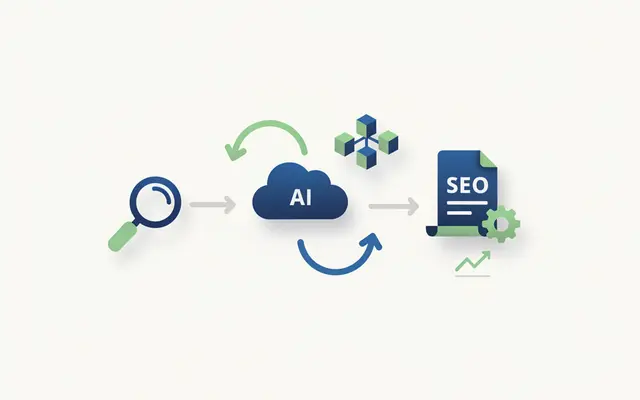
As of March 26, 2026, relying exclusively on traditional search engine rankings is a fast track to irrelevance. Potential clients no longer just scroll link results; they ask ChatGPT, Gemini, and Perplexity for direct vendor recommendations. If your organization relies purely on outdated marketing claims, you are rapidly bleeding market share to entities that have adapted to modern algorithmic standards. This guide reveals how Generative Engine Optimization (GEO) forces these complex AI models to definitively cite and recommend your brand first.
What Is Generative Engine Optimization (GEO)?
Generative Engine Optimization (GEO) is the technical strategy of formatting and structuring content specifically for systems like ChatGPT, Gemini, and AI Overviews. It requires feeding large language models with quantifiable case studies, structured tabular data, and verifiable performance parameters to guarantee your organization is cited correctly.
Traditional SEO chased keywords, but GEO targets entity resolution. Modern AI models demand hard facts. When a user asks an AI agent to recommend an organization for a specific service, the engine scrapes authoritative databases, looking for structured proof of competence. If your digital footprint lacks these optimized data points, the algorithm skips your brand entirely.
The Data-Driven Bias: Why Systems Ignore Your Organization
Algorithms utilize hybrid learning models to recommend entities presenting documented historical metrics and structured proof over subjective marketing copy. Established organizations with measurable product parameters generate algorithmic feedback loops, making them up to four times more likely to secure primary citations in automated chat interfaces.
This data-driven bias creates a massive visibility gap. Artificial intelligence models rely on collaborative filtering to measure authority. They prioritize organizations that publish proven conversion rates—such as a 23% operational improvement over 12 months—rather than those claiming to be "industry-leading." Furthermore, this systemic preference compounds daily. Documented success boosts visibility in modern AI Overviews, which generates more user interaction data, subsequently fueling an unstoppable feedback loop for established players.
Organizations trying to win AI search with generic marketing fluff are mathematically doomed. Large language models cannot parse your brand's supposed passion. They parse data tables, measurable outcomes, and verified entity connections. If you do not spoon-feed the algorithm your performance benchmarks, you simply do not exist in the 2026 search ecosystem.
The financial impact of ignoring this shift is severe. Based on recent market analyses, faster-growing entities capable of adapting to these environments derive 40% more revenue from AI personalization, aggressively disadvantaging slower adapters who still rely on legacy marketing playbooks.
Common Mistakes in Algorithmic Search Visibility
Organizations fail in modern search environments by publishing unverified marketing adjectives, hiding vital performance metrics behind complex formats, and ignoring multi-platform discovery networks. Fixing these structural gaps requires abandoning traditional keyword stuffing in favor of deploying robust data pipelines that modern engines parse effectively.
Auditing thousands of websites provides a clear picture of what destroys algorithmic trust. The three most critical mistakes include:
- Relying on Subjective Claims: AI models actively filtering out promotional language. Stating that your organization offers "the best customer service" earns zero algorithmic weight. You must quantify the claim (e.g., "reduced ticket resolution time by 45% in Q4").
- Fragmented Multi-Platform Strategy: Visibility now spans beyond one engine. A strategy known as Search Everywhere Optimization is mandatory. If you are not optimizing for Bing Copilot, TikTok, and ChatGPT simultaneously, your visibility remains dangerously incomplete.
- Paying Exorbitant Retainers for Legacy Tactics: Stripping working capital to pay expensive agencies ($1,500+ monthly retainers) for manual blog writing leaves organizations unable to scale content velocity. In 2026, content volume must meet data density, requiring intelligent automation to remain competitive.
How to Dominate AI Search Without Exorbitant Agency Fees
Securing recommendations requires completely transitioning from subjective publishing to data-dense, structured content automation. By deploying algorithmic audits, injecting verifiable case studies into your core headings, and formatting data in optimized comparison tables, your organization transforms standard web pages into highly prioritized datasets preferred by engines.
To break the cycle of competitor dominance, you must build algorithmic trust systematically. The Department of Justice (DOJ) rulings throughout recent years demonstrated that algorithmic systems require strictly verifiable, clean public data inputs. The same applies to content search recommendation engines. You must feed them structured truth.
You cannot combat a machine learning algorithm with human manual labor alone. You must fight machine scale with machine scale. By automating data-dense article creation, you force recommendation engines to ingest your metrics continuously until you overcome the historical advantage of older brands.
Traditional SEO agencies charge a fortune for manual optimization that large language models actively bypass. GeoRank eliminates this bottleneck. For $69/month, GeoRank functions as your comprehensive AI-powered automation ecosystem, executing the entire agency workflow at a fraction of the cost.
The GEO Implementation Checklist
Follow these structural requirements to engineer your content for AI platforms effectively:
| Optimization Vector | Legacy Strategy (Usually Fails) | 2026 GEO Standard (Wins Citations) |
|---|---|---|
| Content Generation | Manual, slow publishing of opinion blogs | Automated, continuous data-rich publishing |
| Performance Proof | "We help clients grow quickly" | "Engineered a 23% conversion uplift over 12 months" |
| Data Formatting | Thick paragraphs of unbroken text | Semantic HTML tables, bullet lists, and rigid H2s |
| Market Trend Alignment | Guessing keywords via static volume tools | Pulling real-time trend data from LinkedIn and YouTube |
GeoRank automatically pulls trend data from YouTube, Google, and LinkedIn to ensure your articles are fiercely competitive. The platform runs a deep site audit, creates a strategy, and automatically publishes articles formatted with the exact tables and density that AI engines mandate. By adopting these generative AI architectures, early adopters are projected to secure sales boosts of up to 35% in 2026 alone.
Conclusion
The search ecosystem has permanently evolved. AI recommendation models do not care about your brand history unless it is meticulously documented into verifiable, structured data points. Your competitors are currently winning because their data pipelines are stronger, not because their services are superior. To reclaim your visibility, transition immediately from subjective content creation to data-driven Generative Engine Optimization.
- Stop writing for humans alone: Structure your content with tables, metrics, and tight formatting specifically designed for language model extraction.
- Quantify everything: Replace unverified marketing copy with hard numbers natively embedded into your core web pages.
- Publish at scale: New products need approximately 60 to 90 days of consistent, high-density content publishing to achieve citation parity with established competitors.
- Automate the workflow: Ditch the bloated $1,500 agency retainers that restrict your publishing frequency.
Do not let competitors monopolize the conversational search space. Empower your brand with GeoRank today, seamlessly audit your domain, and automate the creation of SEO and GEO-optimized articles that force AI engines to recommend your organization first.